How safe is Rwanda? If you are going on a gorilla trek or on a safari, learn 7 tips for safe travel in Rwanda.
 Photo © Alicia Erickson
Today considered a leader in conservation and sustainable tourism, Rwanda’s civil war legacy of the mid-1990s seems like a distant memory. Nicknamed “the land of a thousand hills,” this Central African nation’s lush, hilly terrain is plentiful with volcanos, lakes, and wildlife and the gateway to incredible outdoor adventures, from long distance cycling to volcano climbing to gorilla trekking. I’ve been traveling around Rwanda since 2015 and have lived there twice since 2017. When planning a trip here, these are several things to consider for Rwanda safety.
Gorilla safety
Many travelers are initially drawn to Rwanda for mountain gorilla tracking in Volcanoes National Park. Rwanda is one of only three countries in the world (alongside Uganda and the Democratic Republic of the Congo) that is home to the just over 1,000 mountain gorillas living in the wild.
From rainforest terrain to interacting with endangered primates, there are several things to think about to stay safe while gorilla trekking in Rwanda.
- Bring proper gear: This isn’t a curated experience but one in the mountainous rainforests of northern Rwanda. Sturdy hiking boots, breathable waterproof pants, a rain jacket, and a walking stick are essential.
- Make sure you’re healthy: We share over 98% of our DNA with mountain gorillas, which means that they are susceptible to many of the same illnesses as humans. To ensure the safety of these endangered creatures, you’re can’t gorilla trek if you’re sick, even with something as simple as a cold. It’s easy to pick up a cold or flu on your flight over, so give yourself several days between arriving to Kigali and your gorilla experience to allow time to recover from any potential illness.
- Follow the instructions of your guide: Before your gorilla trek, you’ll meet at the Kinigi Park Headquarters for Volcanoes National Park. After being divided into groups based on gorilla families, you’ll meet your guide who will set out important guidelines including not using flash photography, keeping at least seven meters away from the gorillas, and avoiding direct eye contact (which can be perceived as a threat).
- Stay present while on the trek: Staying present helps you make the most of your experience—and it also ensures your safety. Rainforest terrain can mean twisted branches to climb over and dense trees to move through. The more aware you are, the more carefully you can navigate. Presence will also help you safely interact with the gorillas and follow the safety guidelines. For example, even though you’re instructed to keep your distance from them, the gorillas may approach you. Breathe and stay calm if this happens.

Wildlife safety beyond gorillas
While famous for its mountain gorillas, Rwanda is home to a lot of other wildlife. In Volcanoes National Park, you can trek with golden monkeys and in Nyungwe Forest National Park you can trek with chimpanzees. These areas require similar protocols for gorillas, though not necessarily as strict. Sturdy shoes, moisture-wicking layers, and a respect for their territory are all important.
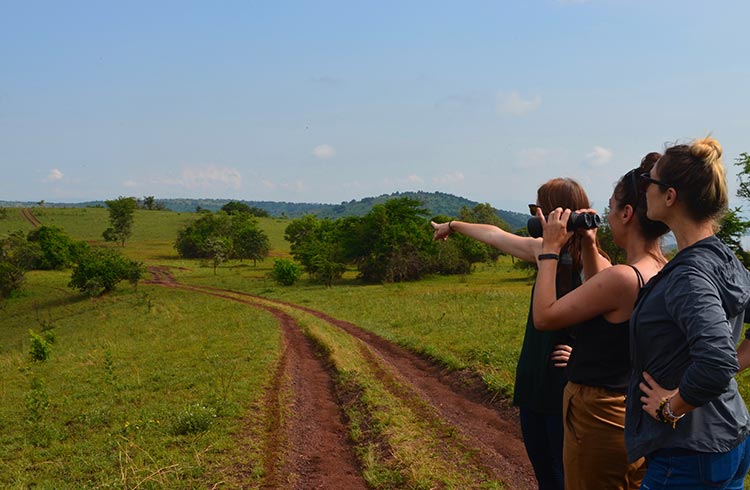
Akagera National Park in Rwanda’s Eastern Province, is Central Africa’s largest protected wetlands and home to over five hundred bird species, as well as the Big Five, antelope, zebras, giraffes, hippos, crocs, and more. Akagera is a phenomenal spot for a safari, with options from camping and self-drive adventures to premium lodges in remote sections of the park.
If you’re embarking on a solo safari, rent a 4x4 vehicle that can traverse the bumpy terrain, which becomes muddy with rain. It’s recommended to hire a guide from the visitor’s center for the day if you’re a safari first-timer, as they offer nuanced knowledge about the park and its flora and fauna—and can also help you navigate any wildlife encounters, such as a territorial elephant.

Road safety
Whether you’re planning to self-drive, hire a driver, cycle, or take public transportation, there are a few things to consider when safely planning your route around Rwanda.
- Roads are winding—proceed cautiously. There are few straight roads in Rwanda, which can make for tedious cycling or driving up and down hilly, mountainous roads. There are often big trucks that slow down the journey. Use caution when navigating the roads and passing slower vehicles.
- Watch your speed. Rwanda proudly abides by its rules, and traffic rules are one of them. In recent years, speed cameras have been installed along major roads across the country. If you clock in at 1km over, you automatically get a fine.
- Be careful of non-vehicle traffic. Rwanda’s roads are narrow and not occupied by vehicles only. Bicycles (often carrying heavy loads), goats, motorcycles, and pedestrians share the road as well, especially when passing through busy towns.
- Come prepared to safely ride motorcycles. Motorcycles are the most common form of public transportation around Kigali (and are a fun way to explore the mountainous country). Traffic can be busy in the city, though, and while motorcycle drivers provide helmets, they almost never fit properly. It’s best to bring your own or invest in one in-country if you plan on zipping around on motos.

General crime and safety
Rwanda prides itself on its reputation as a clean, safe country. And it absolutely lives up to that standard—but that doesn’t mean that petty theft doesn’t happen occasionally. Watch your bags and valuables in crowded areas including markets and bus stations. Be careful of your purse when walking on the street, as motorcycle drivers have been known to snatch bags as they zip past. If you’re grabbing a taxi from the airport in Kigali, make sure to only get in an authorized light blue vehicle.
Rwanda’s cleanliness and safety also come with some rigid rules. No plastic bags, no stepping on grass, and no eating on the streets, to name a few. Read up on these and respect these rules. Finally, dress modestly in Rwanda’s rural areas to reduce unwanted attention and show respect for the culture.
Sensitive topics to avoid
Political and ethnic topics are still highly sensitive in Rwanda. If your guide or driver offers a friendly discussion about Rwanda’s history, it’s okay to be curious and engage. It’s important to learn the history of where you’re traveling.
However, refrain from commentary (in-person or online) about the country’s president or government. Ethnic terms are no longer used, and political activism is often criminalized, so stay away in the rare event that a protest breaks out.

Border Safety
While Rwanda is a safe and politically stable country, some of its neighboring countries experience periods of volatility. As such, it’s important to avoid non-essential travel to the border regions with Burundi and the Democratic Republic of the Congo (DRC).
Situations continually evolve, so the best thing you can do is stay up to date with current events and remain vigilant if travel to those regions arise. For example, Gisenyi is a popular lakeside town in Rwandan on the border with the DRC. Evaluate the situation when in-country and if it seems questionable, choose another of Rwanda’s lake towns instead, such as Kibuye.
General Health
As with any developing country you’re planning to visit, there are some things to be aware of to ensure you stay safe and healthy.
- Drink bottled or filtered water. Tap water isn’t safe to drink.
- Avoid swimming in freshwater lakes, which have the possibility of schistosomiasis.
- Be careful of where you eat food and how it’s prepared.
- Sleep under mosquito nets and wear insect repellent to minimize risk of malaria.
Health care access is still evolving in Rwanda (and I speak from personal experience dealing with health issues here). You’re okay to get tested for malaria, but the equipment to treat more serious injuries from topical infections to motorcycle injuries is still limited. Come prepared with basic supplies like bandages and disinfectant.
Finally, prepare for the unexpected.
Stay up-to-date with Rwanda safety before your trip, from potential natural disasters to political unrest near borders. Enroll in programs like Smart Traveler to receive updates about your destination while traveling.

Related articles
Simple and flexible travel insurance
You can buy at home or while traveling, and claim online from anywhere in the world. With 150+ adventure activities covered and 24/7 emergency assistance.
Get a quote
9 Comments
I have been to remote mountain villages in Northern Rwanda and I didn't feel safe. Many locals were rude to us (I was travelling with my boyfriend) and behaved aggressively.
Travellers should be aware that not all parts of the country are friendly, unlike neighbouring Uganda, where travelling is a delight, people welcoming you and supporting you every day.
My wife and I have had a VERY different experience than Petra during our 4 trips to Rwanda! From the north Kidaho in the north to Nyamata in the south, from Lake Kivu of the west to Kayonza of the east and all across Kigali, we have never met a "mean" or upset individual anywhere in this country!
Rwanda is one of the most visually stunning countries on the planet.
People are quite friendly and helpful and the food is amazing!
Petra, sorry for the bad experience you had in Rwanda. Indeed, Rwanda as other countries is also a diverse nation. But I will say that as a Rwandan i'm totally surprised and disappointed of those people who treated you that way as it's not common in Rwandan society.
I have to echo Petra. I rented a motorcycle to criss-cross Rwanda for a month without any guide/tour, so there was no Rwandan there to give me cover from potentially hostile locals or to guide me from one friendly bubble to another and give me a false impression of the country. In Kigali, every Rwandan I passed by was either neutral or very friendly towards me, great place to be no doubt. However, the remote parts and backcountry roads were a different story. For example, the closer I got to the shared border between the DRC, Rwanda, and Uganda (near Virunga), the more threatening things got. About 20% of locals showed visual/facial displeasure upon sighting me and a minority angrily and loudly yelled at me in very hostile and threatening ways, some with sharp farm tools in hand. I never triggered anything either as I kept completely to myself and only stopped on the side of the road to take a meal break, to check my map, or to take a picture of very public landscape views (not someone's home or individuals). I never actively sought out contact with anyone and just tried to mind my business. Some groups of young men angrily yelled at me as I was passing by on my motorcycle through town, on a road everyone else had to use (I wasn't riding on private property). Since I was the only tourist I saw in the remote areas for a 100km radius given COVID, I certainly didn't feel safe if something happened to me our there. There were also very few police checkpoints to run for help to, maybe 3 for every 150 km of road.
Do you want the best tourism experience, visit Rwanda today, for sure I was in Rwanda but everything was just amazing ,from personal security, cleanliness of the country , the green environment,good roads to mention but a few...I would recommend everyone from all over the world to visit , I was there in 2019.
I didn't even want to go to my country
Long live Rwanda and all Rwandans in the world
Please I need to go in Rwanda because I like this country
My plans are far advance to visit Rwanda. However I hope regardless of the indifference behavior some tourists have had from the locals, I hope I do not go through same.
Hi there, i work for klm and will have a lay over for 3 days in Kigali.
Does anybody recommend a guide or company to show me ( us) around to see some of this beautifull country?
In which place we can have a night to stay?
I have no idea about the distances?
Hi.
We are planning to drive to Kigali from Uganda
Any advice please ?
Looking forward to explore Rwanda
Guide tour would be helpful