Roderick Eime shares his tips for travelers to stay safe in Greenland. From hiking and kayaking to Arctic mosquitoes, here’s what you need to know.
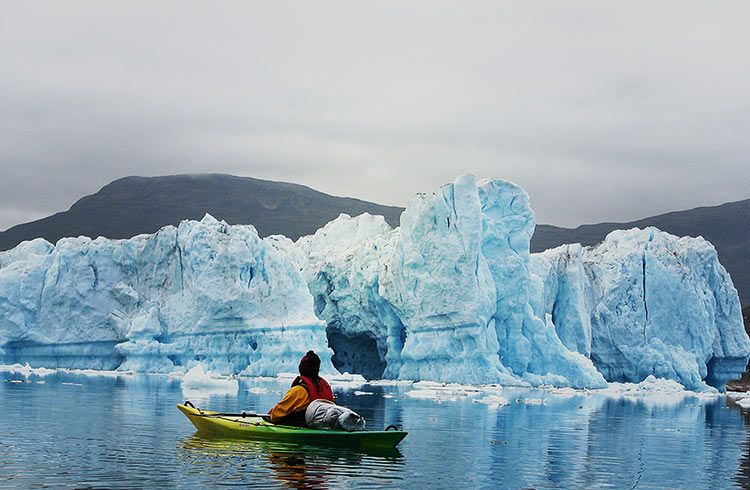 Photo © Getty Images/Jordi Flores / FOAP
If you travel to Greenland, you will almost certainly arrive as I did by either ship or commercial aircraft. I found that traveling in Greenland is not a particularly dangerous activity. At more than 836,300 mi² (2,000,000km²) – twice the size of Western Australia or just a bit larger than Alaska – Greenland is the world’s largest island, with 75% of its landmass above the Arctic Circle and 80% encased in ice.
With a population of barely 60,000 people – about the size of a large country town – Greenland only has a dozen population centers, most of them on the milder western coastline.
Greenland is not the sort of place where you have to keep looking over your shoulder, but rather at your feet because you’ll most likely be hiking somewhere rough and rocky. Here are my top tips to stay safe in Greenland.
- Is there any crime in Greenland?
- Visas and entry
- Food and water in Greenland
- Hiking safety in Greenland
- Go with an experienced guide and pack right
- Arctic mosquitoes
- Safety tips for kayaking in Greenland
- Enjoy the wildlife from a safe distance
- Listen to The World Nomads Podcast: Greenland
1. Is there any crime in Greenland?
Greenland is not a place you have to worry about crime. According to the statistical website, Numbeo, Greenland rates as low for crime and high for safety. The capital Nuuk's low Crime Index of 21 compares favorably with other large Australian cities like Melbourne (44) or US cities like Los Angeles (43), although the number of reported rapes among younger residents is alarming especially in the remote villages. But for regular travelers, crime is all but non-existent.
2. Visas and entry
Greenland is a country administered as part of the so-called ‘Danish Realm’ and is easy to visit for most travelers and visitors from the USA, UK, Australia and Canada who do not require visas.
Residents of countries, like South Africa and Russia, will require visas, so if in doubt, click here to read the list of nationalities that will require a visa for Greenland.
3. Food and water in Greenland
Be careful by all means, but Greenland has clean, safe drinking water everywhere. Otherwise, just take normal hygiene precautions as you would anywhere.
The indigenous Inuit Greenlanders' diet, as I found out, is naturally restricted to what they can harvest from the sea. As such, there is little in the way of vegetables apart from the few berries, tubers and grasses that grow on the uncovered land.
Of course, it is polite to accept food offered to you by your hosts, but some dishes might challenge your palate. One item I have tried on more than one occasion is Muktuk, a frozen and cured form of whale or seal skin and blubber. It's one of the few native foods I cannot tolerate.
The type of whaling conducted in Greenland is classified as ‘Aboriginal Subsistence Whaling’, which means small-scale, not-for-profit and in order to meet the nutritional and cultural requirements of Indigenous people. Travelers should reach their own conclusions on whether or not to eat it.
4. Hiking safety in Greenland
Most travelers visit Greenland for its scenic beauty and adventure activities like hiking and kayaking.
- If hiking, wear sturdy, well-worn in, grippy, closed footwear as trails can be uneven and rocky or even icy in patches
- The cool Arctic climate can be very pleasant in summer with averages of around 50ºF (10ºC) (although these averages are rising). My advice is to pack clothing you can layer, which is particularly applicable to outdoor activities in Greenland
- Make sure your outermost layer is water/spray proof, and your innermost layer is warm. Merino undergarments are excellent. A beanie and gloves are useful too.
5. Go with an experienced guide and pack right
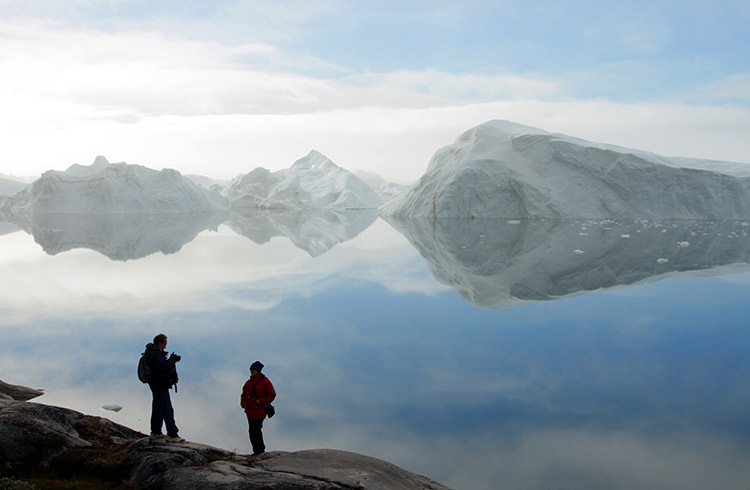
If you’re traveling in unfamiliar territory, it’s wise to go with a guide, and, just like hiking anywhere, carry sufficient water, a sun hat, sunglasses, trail snacks and insect repellent.
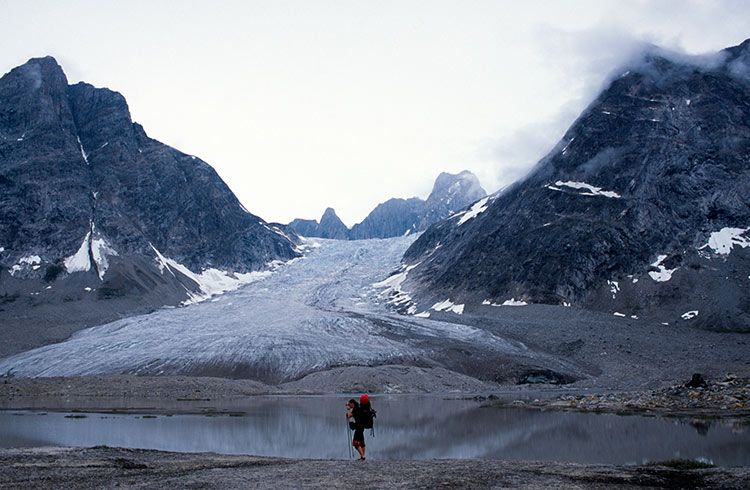
Greenland is a great destination to see and walk on glaciers, but the latter is a precarious activity and should be avoided unless you are with an experienced guide on a marked path. Don't wander off, as glaciers can shift and crumble without warning.
6. Arctic mosquitoes
Arctic mosquitoes are legendary and ferocious, but you can avoid these pests by wearing a net around your hat, staying close to the sea (for the breeze) or using a repellent. Light colored clothes are less attractive to mosquitoes.
I discovered the local solution to this problem is to take the leaves from the Labrador tea (qajaasat) plant, squash them in your hand and rub the juice on any exposed areas.
If you must use commercial repellents, use a liquid or cream, as sprays are not eco-friendly.
7. Safety tips for kayaking in Greenland
If you’re kayaking, wear a dry suit to insulate yourself against the freezing water in case a capsize occurs. Kayak tour operators in Greenland will supply these along with instructions and tips.
One of the most important safety tips when kayaking in any Arctic location is to keep well clear of icebergs. It’s tempting to get up close to see these big blue beauties, but icebergs can roll without warning and, take it from me, you don’t want to be anywhere near an iceberg the size of a five-story building when it decides to invert itself.
The same goes for glaciers; never kayak within 650ft (200m) of a glacier face because when they calve, as they frequently do, they will throw a wave big enough to surf on. If a big wave is heading toward you, quickly point the bow (front) of your kayak into the wave and meet it head-on.
8. Enjoy wildlife, but keep your distance
The most dangerous animal in the Arctic is the polar bear but as a summer visitor to Greenland, you are unlikely to ever see one, much less find yourself in a life-threatening encounter.
Sled dogs might look cute, but never approach one. They are often chained near houses and look lonely, but do not be tempted to go and pat one as they can be unpredictable and defensive, and may lash out at a stranger. If the owner is nearby, ask by all means, but the most likely answer will be 'no' - for your own safety.
One animal that you might enjoy seeing is the big woolly Musk Ox, but you should keep a safe distance and be cautious.
Experienced polar expedition leader, Susan Adie of G Adventures, had one encounter with these beasts which she’ll never forget.
“I was guiding a group of guests when we came upon a small herd of beautiful musk ox including calves,” Susan told me, “we stood a safe distance, perhaps 100 yards (91m/300ft), and noted that the herd had taken up their typical defense ring, with the young in the center. What we didn’t see was a big lone shaggy bull who’d been obscured by a large rock. When he wandered into view he was just 40 yards (35m/120ft) or so away and I think we scared each other, because as we slowly backed away, our hearts beating in our throats, the bull stomped loudly, snorted and charged. I was standing between the animal and my retreating guests when he came to a sudden halt just maybe 10 yards (9m/30ft) away, still snorting louder than ever. I think I was about to faint at this point, but the bull decided to run quickly back to his herd while I sat on a rock for a few minutes catching my breath.”
Listen to The World Nomads Podcast: Greenland
Related articles

Simple and flexible travel insurance
You can buy at home or while traveling, and claim online from anywhere in the world. With 150+ adventure activities covered and 24/7 emergency assistance.
Get a quote
12 Comments
Can you please advise which month/s the Arctic mosquitoes are most prominent. Are they found on the West and East Coast of Greenland?
Can one buy the "hat nets" in Greenland, or is it best to get one ahead of time
many thanks
Steve
Hi Steve, I have to admit that during my two visits to Greenland, mosquitoes were not an issue for me and I suspect that will be the same for most visitors. Climate change, however, is affecting things (to put it mildly) and bigger, hungrier mosquitoes are more frequent in certain parts of Greenland, such as Kangerlussuaq near the airport where caribou traditionally come to feed on the fresh Spring shoots and raise their calves. Warmer temperatures mean plants sprout sooner and mosquitoes hatch earlier, so when the caribou arrive they are late for dinner and the nutritious young shoots are gone and the mosquitoes are bigger and ravenous. On the flip side, these mosquitoes do not carry disease and are typically prevalent inland only. Traditionally 'biting season' is late June to late July. If you think you will be travelling at this time, bring liquid or cream repellent (not spray) and a hat net. If you'd like to read more about my time visiting Greenland, see https://rodei.me/2XPDQ79
Very well written article, thank you. I have long been fascinated with Greenland and this seals the deal.
Thanks Roderick for the feedback on mosquitoes in the area
regards
Steve
Great article, very informative and helpful. Makes me want to get there even more!
"At more than 836,300 mi² (2,000,000km²) – twice the size of Western Australia or just a bit larger than Alaska "
?
Greenland = 2.166 million km²
Alaska = 1.718 million km²
Western Australia = 2.646 million km²
So while Greenland is bigger than Alaska, it is significantly smaller than Western Australia
Thanks for a well written helpful artice!
Great article. I always have wanted to visit Greenland. I wish I can make it in the futrure.
I'm from Greenland.
"Along with fried cockroach, it is one of the few native foods I cannot tolerate."
That's the first time I have heard in Greenland.
Didn't knew that we have cockroaches. I had to laugh, is this a joke? Because I never seen cockroaches in Greenland.
Fried cockroaches? Really? I'm from Greenland and this is the forst time I heard such a thing. Does even Greenland have cockroaches? I think not. Maybe you mistook them for something else? Maybe fried Ammassak? Just....wow.....🙄🤦♀️
Hi Erling and Nukaaka,
I believe the author meant that he tried fried cockroach elsewhere and couldn't tolerate it. But it is not clearly written. We will go ahead and take that line out.
Thanks,
Ellen
I’m dying to know what you native Greenlanders think of the movie “Greenland” with Gerard Butler. Where Greenland is an evacuation center for the end of the world. Never thought about Greenland until I saw the movie. Just curious is all.